Address safety first
Move to a safe location if possible, check on others involved, and call 911 when anyone is injured or traffic is blocked.
Practice Area · Kansas City, Missouri
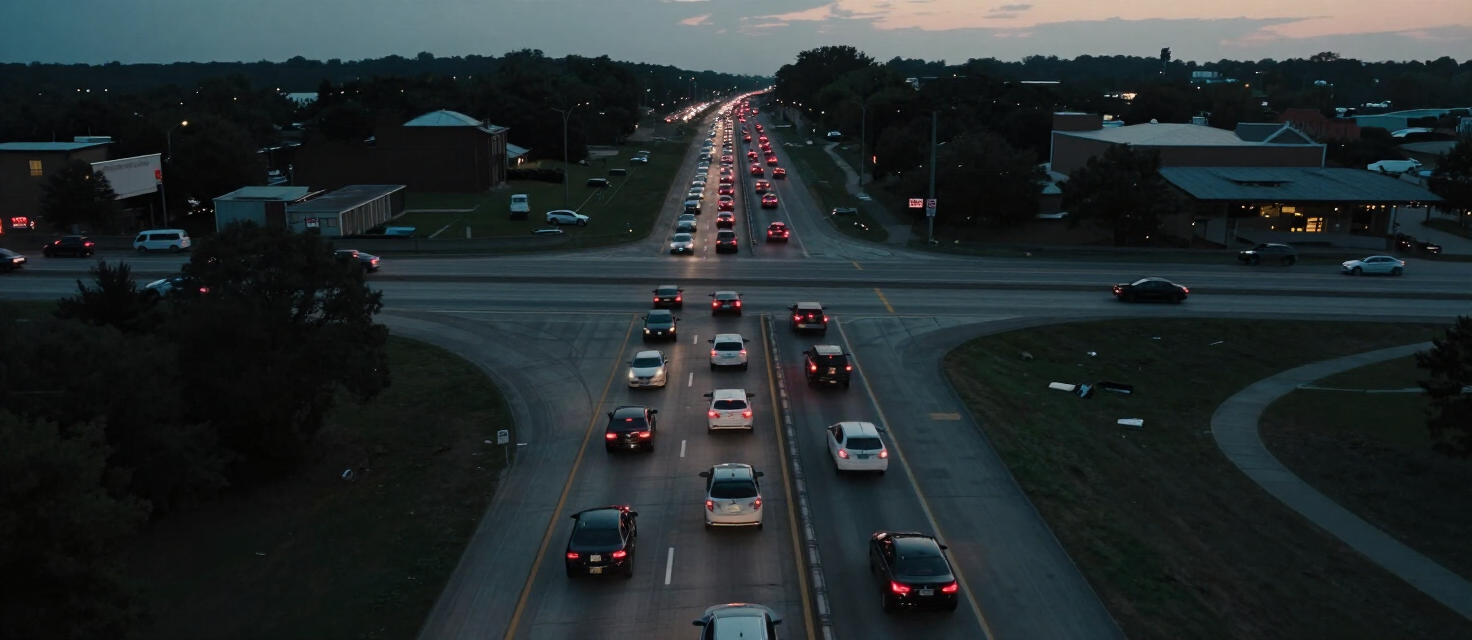
Kansas City combines interstate traffic, commuter corridors, downtown streets, suburban roads, busy intersections, commercial vehicles, rideshare traffic and significant pedestrian activity. The way collisions happen here shapes the evidence behind them — and the work of proving what occurred.
The short answer
Address safety and medical needs first, call emergency services when appropriate, document the scene if it is safe, preserve witness information, keep your medical and expense records together, and be careful about signing documents or giving recorded statements you do not fully understand. The steps below describe general guidance, not individualized legal advice.
What to do after a crash
Move to a safe location if possible, check on others involved, and call 911 when anyone is injured or traffic is blocked.
Some serious injuries are not immediately obvious. Prompt evaluation creates the medical record that later documents what happened to your body.
Photograph vehicle positions, damage, skid marks, traffic controls, road conditions and anything that helps show how the crash occurred.
Responding officers create an official accident report. Note the report number and the agency so a copy can be obtained later.
Independent witnesses can be decisive. Collect names and phone numbers while people are still at the scene.
Medical bills, repair estimates, tow receipts, rental invoices and wage-loss documentation all support the claim.
Common types of Kansas City car accidents
Kansas City traffic moves across interstates like I-35, I-70, I-435 and I-49, the US-71 corridor, the downtown loop and countless suburban intersections. Each setting produces characteristic crash patterns. No roadway is characterized here as dangerous without supporting data.
Common in stop-and-go interstate traffic and at congested intersections; fault is often clear but injury severity is not.
Downtown Kansas City intersections combine signals, turning vehicles and pedestrians, producing frequent angle and turning crashes.
Side-impact collisions at intersections where one vehicle crosses another’s path, often producing serious injuries at lower speeds.
Relatively rare but high-force, frequently involving wrong-way or crossover incidents on divided highways.
Lane-change and merge conflicts on multi-lane corridors like I-435 and I-70, where high speeds amplify the consequences.
Chain-reaction pileups on interstates that raise difficult questions about sequence, fault and each driver’s role.
Collisions where a driver leaves the scene; uninsured motorist coverage and prompt police involvement may both matter.
Crashes tied to phone use, infotainment systems or other inattention, often proven through records and witness accounts.
Impaired-driving collisions raise both criminal and civil questions, and may support additional damages considerations.
Rain, ice and reduced visibility on Kansas City highways change how speed and following distance should be evaluated.
Explore specific crash types
Each collision type raises its own evidence, liability and insurance questions. These supporting resources go deeper into the crash patterns Kansas City drivers encounter most.
Important evidence
Vehicles are repaired or scrapped, skid marks fade, traffic and business video is overwritten on short cycles, and witnesses move or forget. Identifying and securing evidence quickly is often what separates a well-supported claim from a disputed one.
Scene, vehicle damage, road geometry, traffic signs and visible injuries captured close to the date of loss.
The official narrative, contributing factors, citations and identifying information for everyone involved.
Accounts from people who saw the crash, gathered while memory is detailed and before contact information is lost.
Event data recorder information capturing speed, braking and seatbelt use in the seconds before impact.
Emergency, imaging, surgical and therapy documentation that connects the injury to the collision.
Skid marks, debris fields, sightlines and signal timing that reconstruction can later interpret.
“The strongest case is rarely the loudest one. It is the one whose every claim is backed by a document, an image, a measurement or a witness.”
Common injuries
These are categories of injury, not diagnoses or predictions. Some serious injuries are not immediately apparent on early evaluation, which is why prompt and consistent medical care matters for both health and documentation.
Concussions and more severe brain trauma that may not appear on early imaging.
Herniated discs, fractures and soft-tissue cervical injuries with lasting consequences.
Fractures, joint damage and ligament tears requiring surgery and rehabilitation.
Organ damage and internal bleeding that can be life-threatening if not identified quickly.
Whiplash and strain injuries that are real but can be harder to document.
Lasting visible and functional consequences that affect work and daily life.
Insurance issues
Adjusters represent the insurer, not the injured person. They investigate liability, review medical treatment and determine what they believe a claim is worth. Understanding that process helps injured people engage with it on equal footing.
Potential damages
Recoverable damages depend on the facts and applicable law. Potential categories may include medical expenses, future medical needs, lost income, reduced earning capacity, property damage, pain and suffering, permanent impairment and other legally recoverable losses. Nothing here promises that any particular damages will be recovered, and no settlement calculator is offered.
Hospital, surgical, imaging, therapy and prescription costs already incurred.
Care and treatment a provider anticipates will be required.
Wages and earnings lost during recovery and treatment.
Long-term impact on the ability to earn at the same level.
Repair or replacement of a vehicle and damaged belongings.
The physical and emotional experience of the injury and recovery.
Lasting limitations on movement, cognition or function.
Additional categories recognized under applicable Missouri law.
Settlement versus litigation
Most car accident claims settle through negotiation rather than trial. But claims are generally valued higher when the work behind them is genuinely trial-ready. A claim that is prepared as though it may be tried tends to negotiate from a stronger position — and is ready if negotiation stalls.
A demand supported by organized medical records, documented losses and clear liability evidence gives an adjuster reason to evaluate the claim seriously. Many matters resolve here without suit being filed.
When a fair resolution is not offered, suit may be filed. Formal discovery, depositions and motion practice follow, and a matter is prepared to be tried before a judge or jury if it does not resolve.
Frequently asked questions
General information only, not legal advice for any particular situation.
Keep exploring
What happens when the at-fault driver has no coverage or not enough.
The stages a serious claim may move through, from first call to resolution.
Recorded statements, authorizations and settlement conversations explained.
How records, imaging and provider narratives build a claim.
Free case review
This is the intake experience a Kansas City injury firm would offer: clear fields, plain language and no pressure. On this demonstration site the form is entirely inert — nothing you type leaves your browser.
Demonstration only. No information is transmitted to an attorney or law firm.
Demonstration form only. Information entered here is not transmitted to a law firm or attorney.