Phone use
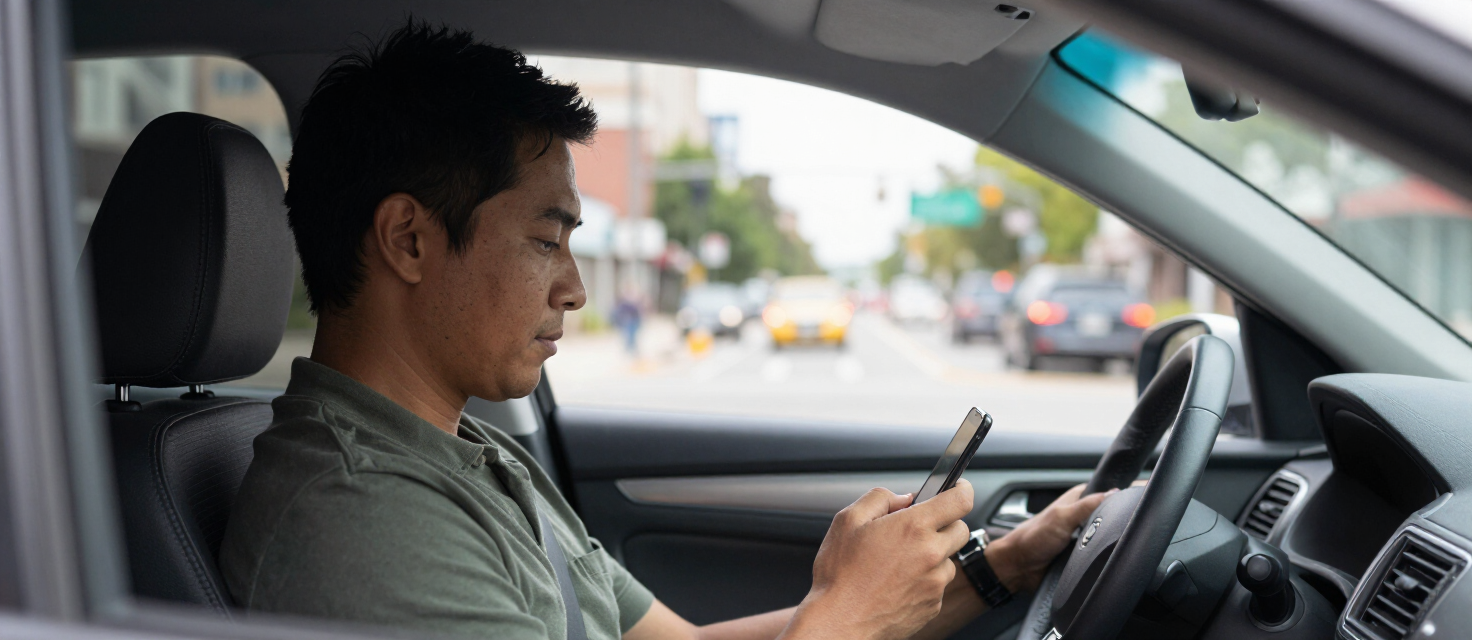
Reading, typing or scrolling on a phone diverts eyes and attention for the seconds a crash happens in.
Car Accidents · Distracted Driving
Distracted driving crashes happen in the seconds a driver’s eyes, hands or attention leave the road. Because no driver admits to it, distraction is usually proven through records, data and witness accounts.
The short answer
Distracted driving crashes happen in the seconds a driver’s eyes, hands or attention leave the road. Because no driver admits to it, distraction is usually proven through records, vehicle data, dashcam footage and witness accounts — not assertion. This page explains the kinds of distraction and the evidence that may become relevant, without assuming any specific driver was distracted. It is not legal advice about any particular crash.
Common distractions
These are categories of distraction, not conclusions about any specific driver.
Reading, typing or scrolling on a phone diverts eyes and attention for the seconds a crash happens in.
Entering an address or studying a map pulls attention from the road ahead.
Conversations, disputes or turning to face passengers take eyes and focus off traffic.
Eating, drinking or personal grooming occupies hands and attention.
Adjusting climate, audio or seat settings while driving creates brief but critical distraction.
A driver lost in thought may fail to register changing traffic even with eyes forward.
Evidence
Relevant evidence depends on the facts. These categories frequently bear on whether distraction contributed to a crash.
Evidence That May Matter
Where legally obtainable, records can show activity around the time of the crash.
Forward-facing footage showing the distracted driver’s vehicle behavior before impact.
Accounts of a driver looking down, holding a phone or failing to react.
Lack of braking or steering input consistent with inattention.
Officer observations, citations and any admissions at the scene.
Damage patterns showing no evasive action before impact.
Which evidence is relevant depends on the facts of the particular collision. This is general information, not legal advice or an investigation of any specific crash.
Kansas City context
Kansas City’s interstate congestion and suburban intersections along Lee’s Summit commercial corridors both create conditions where a few seconds of distraction can cause a crash — a rear-end collision in stopped traffic, or a failure to yield at a signalized intersection. No roadway is characterized here as having more distraction without supporting data; the recurring factor is that distraction compresses reaction time in any setting.
Kansas City area resources
Potential injuries
Categories of injury, not diagnoses or predictions. Crashes with little or no braking can be especially severe.
Soft-tissue neck and back injury from impacts with little or no braking.
Brain injury from head strike or sudden acceleration-deceleration.
Fractures and joint damage, often severe when no braking occurs.
Disc and ligament injury from high-force, unanticipated impact.
Distracted drivers failing to see people outside vehicles cause especially serious harm.
Insurance issues
Adjusters investigate liability and value. Distraction is usually proven, not admitted.
Potential damages
Recoverable damages depend on the facts and applicable law. Nothing here promises that any particular damages will be recovered.
Emergency, imaging, therapy and prescription costs already incurred.
Care and treatment a provider anticipates will be required.
Wages and earnings lost during recovery.
Long-term impact on the ability to earn.
Repair or replacement of the vehicle.
The physical and emotional experience of the injury.
Lasting limitations on movement or function.
Additional categories recognized under applicable Missouri law.
What to do afterward
General guidance, not individualized legal advice.
If you saw the driver looking down or holding a phone, record it immediately.
Report the crash and request officers respond to document the scene.
Vehicle positions, damage, road conditions and any view into the other vehicle.
Bystanders may have observed the distracted behavior too.
Your own records may help refute any comparative-fault argument.
Unanticipated impacts can cause injuries not immediately obvious.
Frequently asked questions
General information only, not legal advice for any particular situation.
Keep exploring
Free case review
This is the intake experience a Kansas City injury firm would offer: clear fields, plain language and no pressure. On this demonstration site the form is entirely inert — nothing you type leaves your browser.
Demonstration only. No information is transmitted to an attorney or law firm.
Demonstration form only. Information entered here is not transmitted to a law firm or attorney.