Traffic signals
Disputes over who had the green light are common. Signal timing data and witness accounts can help reconstruct the sequence.
Car Accidents · Intersection Collisions
Intersection collisions usually turn on right-of-way. Because two drivers often tell different stories, the evidence — signal timing, cameras, witnesses and damage patterns — does the real work.
The short answer
Intersection collisions usually turn on right-of-way: who had the signal, who was required to yield, and who entered the conflict point first. Because two drivers often tell different stories, the evidence — signal timing, cameras, witnesses and damage patterns — does the real work. This page explains the issues generally; it is not legal advice about any particular crash.
Evidence
Relevant evidence depends on the facts. These categories frequently bear on right-of-way and liability in intersection crashes.
Evidence That May Matter
City signal-timing data can show which phase was green when the crash occurred.
Officer observations, citations, diagrams and point of impact.
Bystander and pedestrian accounts of who entered the intersection first.
Where available, city or business cameras may capture the collision itself.
The location and direction of impact help reconstruct vehicle paths and right-of-way.
Expert analysis of speeds, sightlines and signal timing when accounts conflict.
Which evidence is relevant depends on the facts of the particular collision. This is general information, not legal advice or an investigation of any specific crash.
Common circumstances
Intersections concentrate conflict points. These are recurring patterns, not conclusions about any specific driver.
Disputes over who had the green light are common. Signal timing data and witness accounts can help reconstruct the sequence.
Failure to stop or yield at signed intersections produces angle and turning collisions with contested right-of-way.
A left-turning vehicle crossing oncoming traffic is a frequent intersection crash pattern, often turning on who had the right-of-way.
Vehicles entering a through lane from a side street or driveway create conflict points where right-of-way is disputed.
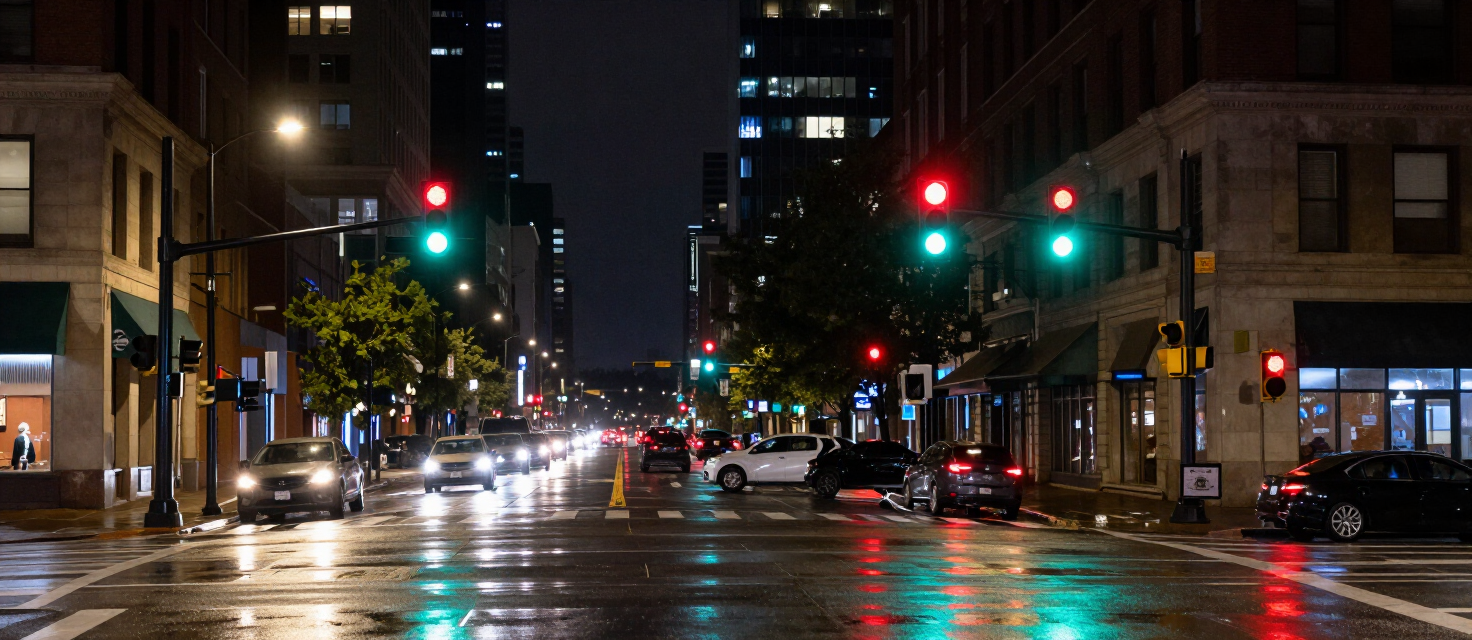
Downtown Kansas City intersections combine turning vehicles with pedestrian crossings, adding a layer of conflict.
Two drivers each claiming the green light is a classic intersection problem that evidence must resolve.
What to do afterward
General guidance, not individualized legal advice.
Report injuries and request that officers respond to document the scene.
Record which light you had, the phase, and any stop or yield signs present.
Vehicle positions, damage, signals, signs, skid marks and sightlines.
Pedestrians and other drivers often saw the sequence clearly.
Note nearby business, traffic or building cameras before footage is overwritten.
Prompt evaluation documents injuries that may not be immediately obvious.
Potential injuries
Categories of injury, not diagnoses or predictions. Side-impact forces can cause serious injuries even at moderate speeds.
Chest, pelvis and head injuries from lateral force, even at moderate speeds.
Head strike or rapid acceleration-deceleration producing traumatic brain injury.
Wrist, arm, rib and leg fractures from bracing, airbag and door intrusion.
Disc and ligament injury from rotational and lateral forces.
Neck and back strain that is real but sometimes slower to document.
Insurance issues
Adjusters investigate liability and value. Understanding the process helps injured people engage on equal footing.
Potential damages
Recoverable damages depend on the facts and applicable law. Nothing here promises that any particular damages will be recovered.
Emergency, imaging, surgical and therapy costs already incurred.
Care and treatment a provider anticipates will be required.
Wages and earnings lost during recovery.
Long-term impact on the ability to earn.
Repair or replacement of the vehicle.
The physical and emotional experience of the injury.
Lasting limitations on movement or function.
Additional categories recognized under applicable Missouri law.
Kansas City context
Downtown Kansas City combines signals, turning vehicles and pedestrian crossings in a tight grid. Suburban intersections along Independence commuter corridors and Lee’s Summit commercial routes produce turning and cross-traffic collisions at higher speeds. No intersection is characterized here as dangerous without supporting data; the recurring factor is that right-of-way disputes are common wherever traffic flows cross.
Kansas City area resources
Frequently asked questions
General information only, not legal advice for any particular situation.
Keep exploring
Free case review
This is the intake experience a Kansas City injury firm would offer: clear fields, plain language and no pressure. On this demonstration site the form is entirely inert — nothing you type leaves your browser.
Demonstration only. No information is transmitted to an attorney or law firm.
Demonstration form only. Information entered here is not transmitted to a law firm or attorney.