DEMONSTRATION WEBSITE — Demo, Stration & Sample is a fictional law firm created to demonstrate professional legal website design. No legal services are offered through this website.
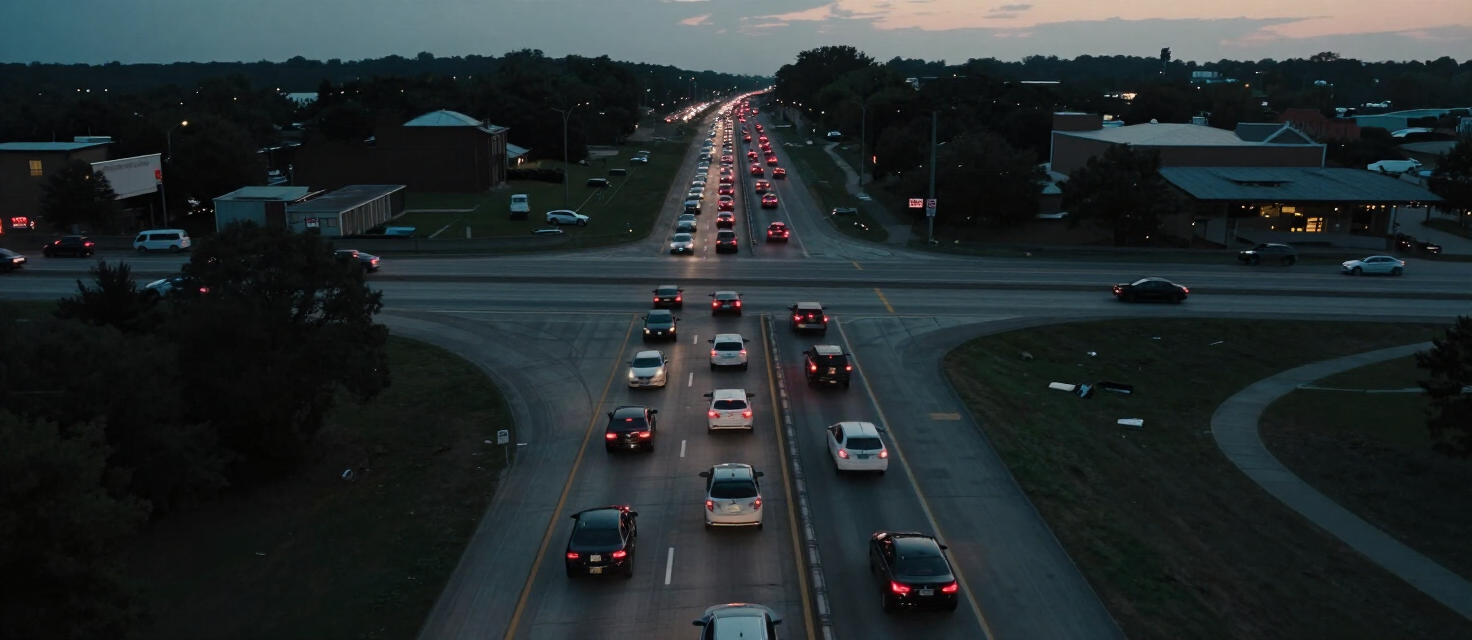
Kansas City interstate interchange at dusk with heavy commuter traffic and brake lights

Answer Center · Car Accidents

Car Accident Questions & Answers

Car accidents raise questions about fault, evidence, and what to do next. These answers cover who may be responsible, how fault is determined at intersections and in rear-end collisions, hit-and-run and multi-vehicle crashes, distracted and impaired drivers, highway accidents, and passenger and borrowed-vehicle situations. General information, not legal advice.

12 questions

01

Who may be responsible for a Kansas City car accident?

Direct answer

Responsibility depends on the evidence — the police report, witness statements, physical damage, vehicle data, traffic-control timing, and sometimes reconstruction. One or more drivers may share responsibility, and in some cases a vehicle owner, employer, or manufacturer may also be involved. Fault is not assumed; it is established from the facts.

More detail

Missouri applies a pure comparative fault approach, meaning recovery may be reduced by the injured person’s assigned percentage of fault rather than barred entirely. How fault is apportioned depends heavily on the evidence developed. The specific duties of each driver — right-of-way, following distance, signal use, speed — are evaluated against what happened.

Related practice area

Car Accidents
02

Who is usually responsible in a rear-end collision?

Direct answer

The rear driver is often responsible because drivers are expected to maintain a safe following distance and be able to stop. But it is not automatic — the lead driver may share or bear responsibility if they stopped suddenly without cause, reversed, or had non-functioning brake lights. The facts of each crash decide it.

More detail

A common misconception is that the rear driver is always at fault. While following-distance principles often point to the rear driver, the lead driver’s conduct matters. Chain-reaction rear-end crashes raise additional questions about sequence and each driver’s role. Reconstruction and vehicle data can clarify what actually happened.

Related practice area

Rear-End Collisions
03

How is fault determined at an intersection?

Direct answer

From the evidence — signal timing, right-of-way, witness accounts, vehicle damage, and any traffic-camera video. Intersections combine signals, turning vehicles, and pedestrians, producing frequent angle and turning crashes. Who had the right-of-way and what each driver could reasonably have seen usually decide it.

More detail

Left-turning vehicles are a frequent pattern: a driver turning across oncoming traffic must yield, but timing and what each driver could see can be contested. If both drivers claim a green light, witness statements, signal-timing records, and nearby video become important. Missouri’s comparative fault may assign a percentage to each driver.

Related practice area

Intersection Accidents
04

What happens after a hit-and-run collision?

Direct answer

Call the police so an official report is created, and preserve any evidence — photographs, witness contacts, and nearby video identified quickly. When the at-fault driver cannot be identified, uninsured motorist coverage on your own policy, or on certain other policies, may apply. Prompt police involvement helps preserve evidence.

More detail

A hit-and-run can make identifying the at-fault driver difficult. Identifying every available coverage layer is an early step. Witnesses, traffic or business cameras, and vehicle damage may help identify the fleeing driver. Even if the driver is never found, uninsured motorist coverage may provide a path to recovery.

Related practice area

Hit-and-Run Accidents
05

What if both drivers say they had a green light?

Direct answer

Both cannot be right, so the evidence resolves it. Witness statements, signal-timing records from the city, traffic-camera video, and vehicle damage patterns can show who actually had the right-of-way. When the evidence is unclear, fault may be apportioned between the drivers under Missouri’s comparative fault approach.

More detail

Signal-timing information can sometimes be obtained from the municipality that maintains the intersection. Independent witnesses who saw the signal phase are especially valuable. Without clear evidence, a jury or insurer may assign shared fault, which reduces each driver’s recovery proportionally.

Related practice area

Intersection Accidents
06

What if multiple vehicles were involved in the crash?

Direct answer

Chain-reaction and multi-vehicle crashes raise difficult questions about sequence, fault, and each driver’s role. Several insurers may be involved, and fault may be apportioned among multiple drivers under Missouri’s comparative fault approach. Early evidence — vehicle positions, damage, and witness accounts — is especially important.

More detail

In a chain-reaction rear-end collision, the middle driver may be partly responsible even if pushed into the lead vehicle. Reconstruction can help establish the sequence of impacts. Each driver’s insurer evaluates its insured’s exposure, and the injured person may pursue claims against more than one at-fault driver.

Related practice area

Multi-Vehicle Accidents
07

What evidence can help prove fault in a car accident?

Direct answer

Photographs of the scene and damage, the police report, witness statements, vehicle event data recorder information, dashcam or nearby video, and sometimes accident reconstruction. Evidence preserved early is frequently the hardest to reconstruct later, because vehicles are repaired, skid marks fade, and video is overwritten.

More detail

Vehicle event data recorders can capture speed, braking, and seatbelt use in the seconds before impact. Traffic or business camera video is often overwritten within days, so identifying it quickly matters. Reconstruction professionals interpret skid marks, debris fields, and sightlines when the sequence is disputed.

Related resource

Evidence Preservation
08

What if the other driver was distracted?

Direct answer

Distraction — phone use, infotainment systems, or other inattention — can be a factor in fault, but it must be proven through records and witness accounts rather than assumed. Phone records, witness observations, and the circumstances of the crash can support a distraction claim. Fault still turns on the evidence.

More detail

Proving distraction often requires subpoenaing phone records or obtaining witness statements about what the driver was doing before impact. The mere fact of a crash does not establish distraction. A distracted driver who violated right-of-way or following-distance rules may bear responsibility under ordinary negligence principles.

Related practice area

Distracted Driving Accidents
09

What if the other driver was intoxicated?

Direct answer

Impaired driving can be strong evidence of negligence in a civil injury claim, and it may also be the subject of a separate criminal case. A civil claim and a criminal DUI case are distinct legal matters with different standards and purposes. The civil claim seeks compensation; the criminal case addresses public offenses.

More detail

A conviction or citation for impaired driving can support a civil claim, but a civil claim does not depend on a criminal conviction. Civil claims may also consider whether aggravated circumstances support additional damages considerations, depending on the facts and applicable Missouri law. The two cases proceed on separate tracks.

Related practice area

Drunk Driving Accidents
10

What if my accident happened on I-70 or I-35?

Direct answer

Interstate crashes often involve higher speeds, merging, and multi-vehicle scenarios, which can worsen both injury severity and the evidence questions. Because I-70 and I-35 cross county lines, the precise location of the crash can affect which county’s courts may be relevant. Preserving scene evidence and vehicle data is especially important.

More detail

At highway speeds, the same error that causes a minor city-street collision can cause catastrophic injuries. Vehicles may travel far after impact, making reconstruction important. The Missouri State Highway Patrol often responds to interstate crashes. Evidence like event data recorder information and dashcam video can be decisive.

Related practice area

Highway Accidents
11

What if a passenger was injured in the crash?

Direct answer

An injured passenger may generally pursue a claim against any at-fault driver, which can include the driver of the vehicle the passenger was in. The passenger’s claim is evaluated on the same evidence as any other injury claim. Which policies apply depends on the facts and the coverages involved.

More detail

A passenger is typically not at fault, so the question is which driver or drivers bear responsibility. The passenger may pursue claims against multiple at-fault parties. Insurance layers can include the at-fault driver’s liability coverage and, in some situations, the passenger’s own or the host vehicle’s coverage.

Related practice area

Car Accidents
12

What if I was driving someone else’s vehicle when the accident happened?

Direct answer

Permission to use the vehicle and the applicable insurance policies determine how coverage applies. The owner’s auto insurance may cover a permissive driver, and the driver’s own policy may also apply, depending on the policies and the facts. Responsibility for the crash itself still turns on who was at fault.

More detail

Coverage questions in borrowed-vehicle situations can involve the owner’s policy, the driver’s policy, and sometimes other layers. A vehicle owner may also bear responsibility in some circumstances, depending on the facts and applicable law. Identifying every available coverage layer is an early step in evaluating the claim.

Related practice area

Car Accidents

More questions

Frequently asked, answered directly.

General information only, not legal advice for any particular situation.

Keep exploring

More questions & deeper resources.

Demonstration website only. No information is transmitted to an attorney or law firm. These answers are general educational information, not legal advice for any particular situation. Demo, Stration & Sample is a fictional law firm.

Free case review

Questions about a car accident? Request a free case review.

This is the intake experience a Kansas City injury firm would offer: clear fields, plain language and no pressure. On this demonstration site the form is entirely inert — nothing you type leaves your browser.

Demonstration only. No information is transmitted to an attorney or law firm.

Office
1100 Main St, Kansas City, MO 64105

Demonstration Case Review

Demonstration form only. Information entered here is not transmitted to a law firm or attorney.

Medical Treatment

No attorney-client relationship is created by submitting this demonstration form, and no information is sent to a lawyer.