DEMONSTRATION WEBSITE — Demo, Stration & Sample is a fictional law firm created to demonstrate professional legal website design. No legal services are offered through this website.
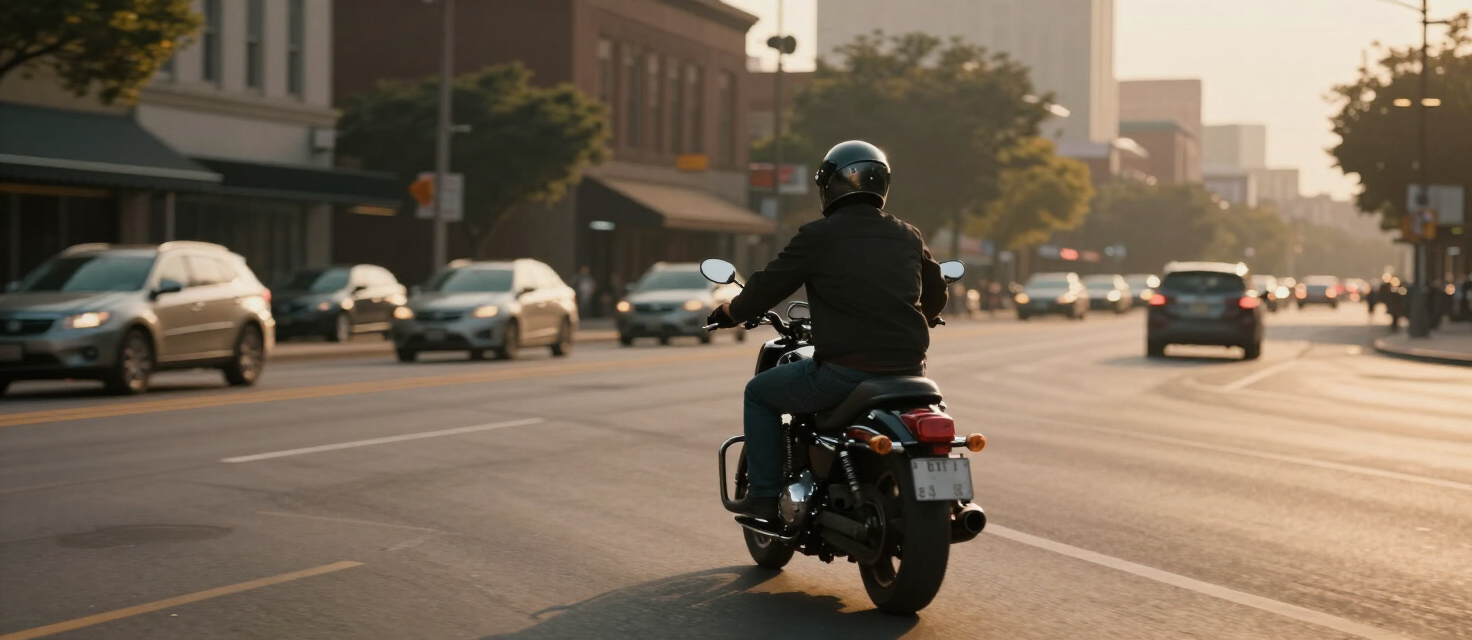
Motorcyclist with helmet riding on a Kansas City urban boulevard at golden hour, viewed from behind

Answer Center · Motorcycle Accidents

Motorcycle Accident Questions & Answers

Motorcyclists have the same right to the road, but when something goes wrong the rider absorbs the force directly. These answers cover what to do after a crash, how fault is determined, left-turn collisions, road conditions, evidence, insurance, catastrophic injuries, and helmet questions. General information, not legal advice.

8 questions

01

What should I do after a motorcycle crash?

Direct answer

Address safety and medical needs first — riders are often thrown from the motorcycle and may not recognize serious injuries immediately. Call emergency services, document the scene and vehicle positions if safe, preserve witness information, and seek medical evaluation. Keep records together and consider qualified legal advice about your circumstances.

More detail

Because riders have no vehicle frame for protection, injuries can be serious even at lower speeds. Prompt medical evaluation protects both health and the record that connects injuries to the crash. Preserve the motorcycle, helmet, and riding gear as physical evidence, and photograph the scene, road conditions, and damage before anything is moved or repaired.

Related practice area

Motorcycle Accidents
02

How is fault determined in a motorcycle accident?

Direct answer

Fault depends on the evidence — the police report, witness statements, physical damage, scene geometry, and sometimes reconstruction — not on assumptions about motorcyclists. Missouri’s pure comparative fault approach may reduce recovery by the rider’s assigned percentage of fault rather than barring the claim. Right-of-way, sightlines, and what each driver could see usually decide it.

More detail

Many motorcycle crashes are caused by another driver who failed to yield, turned across the rider’s path, or changed lanes without seeing the motorcycle. Rider bias — stereotypes about motorcyclists — can affect how a claim is perceived, which is why objective evidence matters. Liability turns on what each person could see and did, not on the vehicle chosen.

Related practice area

Motorcycle Accidents
03

What if a vehicle turned left in front of a motorcycle?

Direct answer

A left-turn accident is a common motorcycle pattern: an oncoming vehicle turns left across the rider’s lane. Fault often turns on timing, signal use, and what each driver could see. The turning vehicle generally must yield to oncoming traffic, but the specific facts — speed, visibility, signal phase — determine how fault is apportioned.

More detail

These crashes often happen at intersections when a driver fails to see or misjudges an oncoming motorcycle’s speed. The rider’s right-of-way is a central factor, but speed perception and conspicuity can also play a role. Witness statements, the police report, and sometimes reconstruction help establish what each person could reasonably have seen.

Related practice area

Motorcycle Accidents
04

What if a road condition contributed to the motorcycle crash?

Direct answer

Potholes, loose gravel, uneven pavement, and debris that a car would barely notice can be hazardous to a rider. Where the hazard came from — a vehicle, a property, or a public roadway — can affect who may be responsible. Road-condition evidence can be especially important where pavement contributed.

More detail

A claim involving a roadway hazard may raise questions about the entity responsible for maintaining the road, and claims against government entities can carry short notice deadlines and special requirements. Photograph the hazard and roadway conditions promptly, because repairs can eliminate the evidence. The source and duration of the hazard are factual questions.

Related practice area

Motorcycle Accidents
05

What evidence is useful after a motorcycle collision?

Direct answer

Scene photographs, the police report, witness contacts, road-condition documentation, the damaged motorcycle and helmet, any available video, and a consistent medical record. Because riders are often thrown clear, vehicle positions and scene geometry can be especially important — and they fade quickly.

More detail

The motorcycle, helmet, and riding gear are physical evidence — photograph and preserve them before anything is repaired or discarded. Road-condition evidence matters where pavement contributed. Witness accounts gathered while memory is fresh are valuable. Pair all of this with a consistent medical record that connects injuries to the crash.

Related resource

Evidence Preservation
06

What insurance may apply after a motorcycle accident?

Direct answer

The at-fault driver’s liability coverage is the first layer. When the driver is uninsured, underinsured, or cannot be identified after a hit-and-run, the rider’s own uninsured and underinsured motorist coverage may become relevant. Identifying every available coverage layer is an early step. Recoverable damages depend on the facts and applicable law.

More detail

Motorcycle injuries frequently involve long-term treatment and reduced earning capacity, so understanding the full coverage picture early matters. Medical payments coverage, where the policy includes it, may also pay medical bills regardless of fault. Multiple coverage layers may coordinate, and the specific policies and facts determine what applies.

Related practice area

Uninsured & Underinsured Motorist
07

Can motorcycle accidents result in catastrophic injury claims?

Direct answer

Yes. Without a vehicle frame, the rider absorbs the force directly, so motorcycle crashes can produce traumatic brain injuries, spinal injuries, amputations, and other catastrophic harm. These claims may need to account for years of future care, lost earning capacity, and the human cost of a permanently changed life.

More detail

Catastrophic injury claims often involve life-care planning, economic projections of future care, and vocational evidence of reduced earning capacity. Because future needs must be understood before the claim can be fairly valued, serious motorcycle claims often take longer to resolve. Settling before the full picture is clear risks leaving future costs uncovered.

Related practice area

Catastrophic Injuries
08

Do motorcycle cases always involve helmet issues?

Direct answer

No. Helmet use can be a relevant factual and legal question in some cases, but it is not central to every motorcycle claim. Whether helmet use affects a particular claim depends on Missouri law and the specific facts, including whether a head injury occurred. This page does not provide legal advice on helmet requirements.

More detail

Missouri law and the facts of the crash determine how helmet use is treated. Where a head injury is involved, helmet use may be examined; where the injuries are to other parts of the body, helmet use may have little bearing. Questions about helmet requirements for a particular situation should be directed to a licensed attorney.

Related practice area

Motorcycle Accidents

More questions

Frequently asked, answered directly.

General information only, not legal advice for any particular situation.

Keep exploring

More questions & deeper resources.

Demonstration website only. No information is transmitted to an attorney or law firm. These answers are general educational information, not legal advice for any particular situation. Demo, Stration & Sample is a fictional law firm.

Free case review

Questions about a motorcycle crash? Request a free case review.

This is the intake experience a Kansas City injury firm would offer: clear fields, plain language and no pressure. On this demonstration site the form is entirely inert — nothing you type leaves your browser.

Demonstration only. No information is transmitted to an attorney or law firm.

Office
1100 Main St, Kansas City, MO 64105

Demonstration Case Review

Demonstration form only. Information entered here is not transmitted to a law firm or attorney.

Medical Treatment

No attorney-client relationship is created by submitting this demonstration form, and no information is sent to a lawyer.