I-35
A north-south interstate connecting downtown Kansas City to the northern suburbs and beyond, carrying heavy commuter and freight traffic.
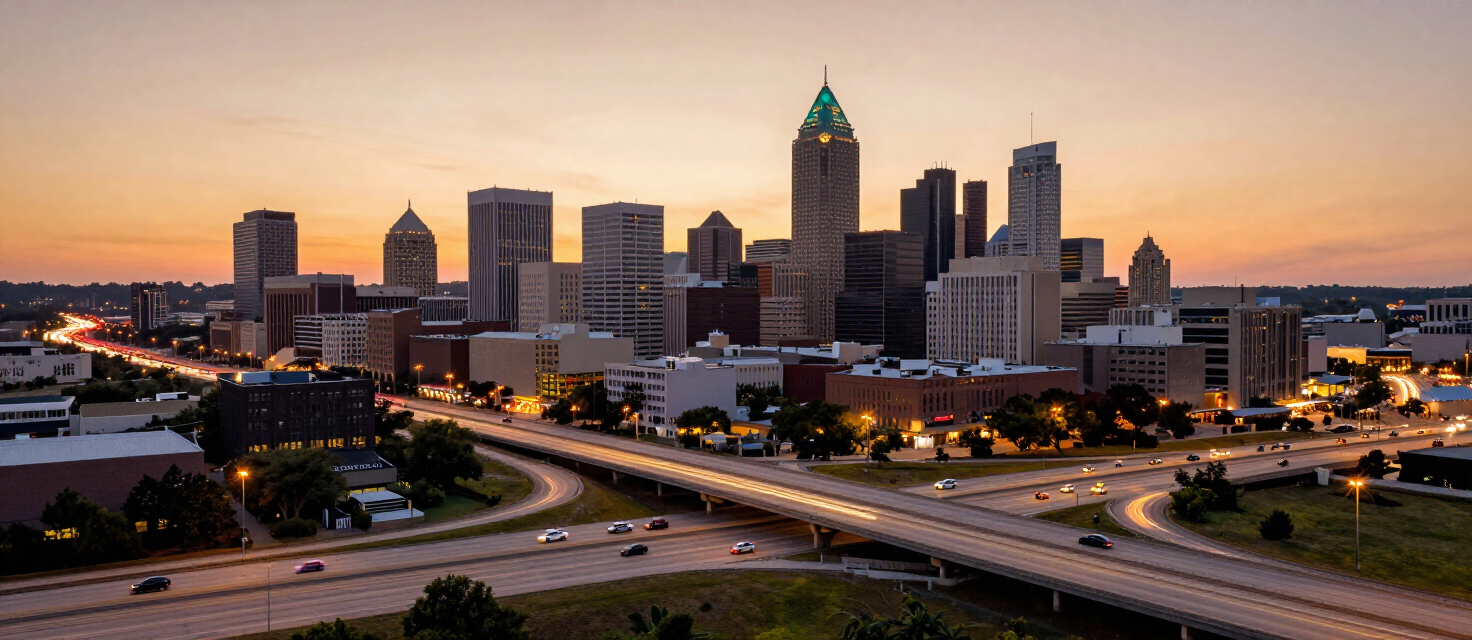
Geographic Hub · Kansas City, Missouri
Kansas City spreads across two states and three Missouri counties, threaded by interstates, river bridges and neighborhood streets. This demonstration resource explains how accident location, county courts, insurance and Missouri law can shape a personal injury claim — without offering legal advice or representation.
About this resource
This page is the central geographic resource on a demonstration website built to show how a Kansas City personal injury firm might organize local information. Everything here is educational and illustrative. Demo, Stration & Sample is a fictional firm, and nothing on this page is legal advice or an offer of representation.
Kansas City is unusual among American cities: it straddles the Missouri-Kansas state line and spreads across Jackson, Clay and Platte counties in Missouri alone. Where a crash happens — downtown, on an interstate, in a suburb or on a neighborhood street — can affect which courts may be involved, which agencies respond and how a claim is practically organized.
This resource connects those geographic realities to the accident and injury topics already covered on this site. From car accidents on I-70 to pedestrian injuries in the Crossroads, the goal is to help readers understand how location intersects with the legal and practical questions that follow a serious crash.
The pages linked below go deeper into individual counties and communities — Jackson, Clay and Platte counties, and cities including Independence, Lee’s Summit, Blue Springs, Liberty, Gladstone, Raytown and Grandview. Each is written as a standalone local resource.
Transportation network
Kansas City’s transportation network is one reason accident location matters so much here. The metro is built around a web of interstates, loop highways, arterial roads and neighborhood streets, and a single commute can cross several jurisdictions. Understanding where a crash occurred is often the first step in understanding which courts, agencies and insurance questions may be involved.
A north-south interstate connecting downtown Kansas City to the northern suburbs and beyond, carrying heavy commuter and freight traffic.
The major east-west interstate bisecting the metro, linking downtown to Independence, Blue Springs and the eastern county line.
The perimeter loop encircling the metro, intersecting nearly every other major route and handling cross-town and bypass traffic.
The southern expressway connecting Kansas City to Grandview, Raytown and the broader southland.
A busy arterial corridor running south from downtown through the urban core toward the southern suburbs.
A north-south route crossing the Missouri River and serving the Northland and downtown fringe.
A surface route through the northern riverfront communities, mixing local and through traffic.
Accidents in the Kansas City area may occur on interstate highways, arterial roads, downtown streets, neighborhood streets and parking areas. This page does not characterize any particular roadway as dangerous; crash risk depends on conditions, driver behavior, time of day and many other factors specific to each incident.
Accident & injury topics
The same crash type can raise different questions depending on where in the metro it happens. These are the accident and injury topics this demonstration site covers, each linked to its own dedicated resource.
Collisions on Kansas City interstates, intersections and neighborhood streets — rear-end, intersection, sideswipe and multi-vehicle crashes.
Explore 02Heavy truck crashes on I-70, I-435 and I-35 involving interstate carriers, local delivery vehicles and complex insurance layers.
Explore 03Motorcycle collisions at intersections and during lane changes, where visibility and right-of-way failures produce serious injuries.
Explore 04Pedestrian strikes in downtown, Crossroads, Westport and the Plaza, where foot traffic meets turning vehicles and limited-sight intersections.
Explore 05Traumatic brain injuries, spinal cord injuries, fractures and permanent impairment arising from high-force Kansas City collisions.
Explore 06Fatal crashes on Kansas City roads and the questions families face about investigation, insurance and accountability.
ExploreWhere a Kansas City crash happens — which interstate, which county, which neighborhood — can shape everything from the responding agency to the court that may one day hear the case.
Missouri counties
Kansas City, Missouri spans three counties. Where a crash occurs can affect where litigation may potentially be filed and which courts or agencies may be involved. These county pages go deeper into each jurisdiction.
Local courts, communities and accident context for Jackson County, Missouri.
View county page County 02Local courts, communities and accident context for Clay County, Missouri.
View county page County 03Local courts, communities and accident context for Platte County, Missouri.
View county pageJackson County
Most of Kansas City’s urban core sits in Jackson County, along with Independence, Lee’s Summit, Blue Springs, Raytown, Grandview and other communities. Accident location within Jackson County can affect where litigation may potentially be filed and which courts or agencies may be involved.
Jackson County is the most populous of the three Missouri counties Kansas City occupies. Its circuit court handles many civil matters arising from crashes in the county, and the Missouri State Highway Patrol, Kansas City Police Department and municipal police agencies all respond to accidents depending on where they occur.
A crash on I-70 near downtown, an intersection collision in Independence, or a pedestrian strike in Lee’s Summit may each raise different practical questions even though all sit within Jackson County. The Jackson County page covers these communities in more detail.
Jackson County communities
Clay County
Clay County lies north of the Missouri River and includes Liberty, Gladstone, North Kansas City and the Northland portions of Kansas City. Crashes occurring north of the river may raise questions about Clay County courts and agencies.
The Missouri River physically separates much of Clay County from the urban core, and the bridges and interstate approaches that cross it carry heavy commuter volume. Accident location north of the river can affect which county’s courts may be relevant and which agencies responded.
The Clay County page covers Liberty, Gladstone, North Kansas City and the Northland in more detail.
Clay County communities
Platte County
Platte County occupies the northwest corner of the Kansas City metro, including Parkville, Riverside, Platte City and the area around Kansas City International Airport. Airport-area transportation and interstate access shape local traffic patterns.
Platte County’s road network is shaped by airport access, interstate connections and the Missouri River. Crashes near the airport, on I-29, or in communities like Parkville and Platte City may raise Platte County court and agency questions.
The Platte County page covers these communities and the airport-area transportation context in more detail.
Platte County communities
Neighborhoods
Within Kansas City itself, different neighborhoods present different traffic, pedestrian and accident contexts. These neighborhood-level notes appear here rather than on separate pages, and are included only where geographically relevant.
The central business district, where office commuters, convention visitors, transit and one-way street grids concentrate traffic at peak hours.
A dense arts-and-dining district just south of downtown, with heavy pedestrian activity, event traffic and limited parking.
The historic riverfront market area with weekend foot traffic, transit connections and a mix of local and visitor drivers.
An entertainment and nightlife district where late-evening pedestrian and rideshare activity rises sharply on weekends.
A major shopping and dining destination with heavy seasonal traffic, pedestrian crossings and complex parking access.
A residential neighborhood with tree-lined streets, neighborhood retail and school-zone pedestrian activity.
A southern residential district with neighborhood commercial nodes, bus routes and family traffic.
The communities north of the Missouri River, reached by bridge crossings and interstate approaches that carry commuter volume.
Insurance, evidence & Missouri law
Beyond location, several practical questions recur in Kansas City accident claims — insurance layers, medical documentation, evidence preservation and Missouri’s comparative fault approach.
Identifying every applicable policy — the at-fault driver, uninsured/underinsured motorist coverage, commercial policies and others — is one of the first steps in a serious claim.
Insurance adjusters may contact injured people within days. Recorded statements and broad medical authorizations can affect a claim, and many people seek guidance before responding.
Emergency records, imaging, specialist notes and therapy documentation connect an injury to the collision and establish its extent over time.
Photographs, vehicle data, police reports, witness contacts and nearby video should be preserved early, before vehicles are repaired and memories fade.
Missouri applies a pure comparative fault approach, meaning recovery may be reduced by the injured person’s assigned percentage of fault rather than barred entirely.
Missouri generally sets a time limit on filing personal injury lawsuits. The specific deadline depends on the claim type and parties, so identifying it early matters.
Courts & government resources
This is general educational context, not filing instructions. Where a matter may be handled depends on the facts, the parties and the claim. Later modules will expand these legal-resource references.
Kansas City primarily falls in Jackson County (16th Judicial Circuit). Clay and Platte counties have their own circuits. The appropriate court depends on the claim.
Kansas City and surrounding cities operate municipal courts for certain local matters. These are distinct from county circuit courts.
The Highway Patrol often responds to crashes on interstates and state routes and prepares official accident reports.
Kansas City Police Department and municipal departments respond to crashes within their jurisdictions and create reports.
Official accident reports are typically available from the responding agency. The report number and agency are noted at the scene.
Various Missouri state and local agencies may be relevant depending on the roadway, the parties and the claim. This site does not provide filing instructions.
Medical resources
Serious accident victims in the Kansas City area may receive emergency or follow-up treatment through local medical facilities. This site does not direct anyone to a particular hospital, does not provide medical advice, and does not imply any affiliation between any facility and the fictional firm. In an emergency, always call 911 or go to the nearest appropriate emergency department.
The Kansas City metro includes multiple hospitals and trauma-capable facilities. Which one is appropriate depends on the injury, the location and the circumstances at the time — a medical decision, not a legal one. Future research modules on this demonstration site will expand these resource references with verified facility information.
Practice areas
These dedicated practice-area and serious-injury pages go deeper into each topic, with Kansas City context throughout.
Surrounding communities
Beyond the Kansas City urban core, these dedicated city pages cover the major Missouri communities in the metro.
FAQ
These answers are general educational information for a demonstration website, not legal advice for any particular situation.
Free case review
This is the intake experience a Kansas City injury firm would offer. On this demonstration site the form is entirely inert — nothing you type leaves your browser, and no attorney-client relationship is created.
Demonstration only. No information is transmitted to an attorney or law firm.
Demonstration form only. Information entered here is not transmitted to a law firm or attorney.